


There is no quick or definite answer to that question. But there are ways to analyze coverage versus cost and feel you are getting what you need at a price you can stomach.

***

“The car won’t start,” texted my wife early on a recent Sunday morning, while I was 1,000 miles away visiting my mom.

She sent me a video, and I brilliantly concluded that the battery was dead. After a few minutes of trying to determine why the battery died, we turned our attention to figuring out what to do about it. It took me a minute to remember that we had AAA. For seven years living in Spain, AAA was not a part of my life, but as soon as I moved back to Maine and got a car, I reupped as that service had towed me, jumpstarted me, and even pulled a loved one out a ditch.

And while AAA is not necessarily marketed as insurance, for me it is and a darn good-value-insurance at that. That got me thinking…

Issue #1: Why Do We Buy Insurance?

Let’s put aside all things related to legally required insurance and focus on our choices. I cannot help anyone into the insurance happy zone as it lives in the same place in our hearts as taxes. What I hope to do is offer a path to peace of mind, to know you are doing the best you can with your insurance costs and choices.

The purpose of insurance is protection against loss; partially restoring our financial position. Contrary to mass-marketing messages and popular belief, insurance is not designed to make us 100% whole after a loss. So, know that going in – we will pay for insurance protection and still have to pay more when we use the insurance.

And, not only have the upfront premiums gone up, the portion we pay in the form of co-pay, co-insurance, and deductibles, has also ballooned.

There are plenty of factors blamed when discussing why the above is true, and I can’t tackle them here. What I can say is 1) insurance companies are in business to make a profit for their shareholders/owners/policyholders 2) losses from natural disasters have increased, and perhaps more importantly, are expected to increase even more with climate change 3) there are more people living in areas affected by these disasters 4) the costs of home repair, car parts, medical care, and liability activity have gone up as fast or faster than almost everything else in our lives.

Deal or No Deal?

It is tricky to determine if your insurance is a fair deal. I say fair because Economists Rule #7 (yes, a nod to my favorite writer, the late Robert Parker) states that you can’t really expect a good deal out of any transaction. If someone is getting a good deal, that means someone else is getting a bad deal. Generally speaking, insurance companies, with their legions of actuaries and analysts, are probably not getting a bad deal when they do business with you, so better to think in terms of fair.

It comes down to premium (cost) versus potential benefit. Potential because we hope to never use our insurance. A few notes:

  • This is subjective. We don’t all value the same things in the same way. This is affected by our habits, experiences, and cultural values. Ultimately, insurance decisions are personal.
  • These are generic examples, aiming at what would be realistic for most folks.
  • Circumstances that affect insurance costs are sometimes out of our control.
  • It’s a moving target. Stay informed, review, and evaluate often.

I’ll offer analysis on a few common types of insurance with ballpark cost/benefit numbers. Thinking about insurance in this way is transferrable to other kinds of insurance and can be a great tool in your personal finance toolbox.

Term Life Insurance: $250/year for 20 years of a $200,000 death benefit for a relatively healthy 40-year-old. Peace of mind. A financial cushion for those who depend on you. A bargain.

Term Life Insurance: A $10,000 “burial” policy for someone over 70, at a cost of $600/year. While coming up with burial costs is a significant financial and emotional burden, $600/year to protect $10,000 is not a strong financial move. In this case it might be better to self-insure, put that $600/year into an investment, and try to save extra for when it’s needed. This is a case of one size does not fit all, and you have to do what feels right.

Mobile Phone Insurance: $200/year premium plus a $100 deductible in case of loss, all to protect a $750 phone. This is a bad deal for the consumer. It’s very little potential coverage for the cost. Put that $200 you would pay for the insurance plus the $100 deductible in your emergency fund and treat your phone like it’s worth $1000.

Homeowner’s Insurance: $1,200/year to insure a $500,000 home, plus $300,000 in liability protection, all with a $1,000 deductible. Sign me up every day. Yes, prices are going up, but the ratio of cost/potential benefit is good for the insured. This is what insurance is meant to do. If you paid these rates for 25 years, it would cost $30,000 plus lost investment opportunities. A lot, yes, but nothing compared to the cost of replacing, repairing, or rebuilding a home, or paying legal fees when a clumsy neighbor trips over your tulips. 

Product Insurance: I recently purchased a $30 fan at a big retailer. They offered additional insurance/warranty for $9.99 for two years of coverage. Hmmm… How do I say this clearly? It’s awful! The insurance costs a full 30% of the price of the product! And many credit cards offer an additional warranty automatically on purchases made with that card. Maybe you are saying, “Yeah, there is NO way I would buy that.” But keep in mind, they do not continue to offer it because no one is buying. A lot of folks are, and it’s incredibly profitable for the company, and the way it’s sold at checkout makes it easy to “include it in the cart” without really thinking about it. Buyer beware.

AAA Roadside Assistance: It’s how this conversation started, so I’ll finish here. My AAA plan is about $100/year. I hope it’s $100 wasted. However, chances are I will use it, just like I had to last week. There are specific benefits that can be measured against the annual AAA fee, and they can be substantial (calling for assistance, towing, jumpstart, etc.) but with this insurance it’s also about the uncountable costs incurred when you or a loved one is stuck on the side of the road in the middle of two things – the night and nowhere.

You can get affordable roadside coverage through your auto insurance as well but be careful to get the full details on what is covered. In my experience, some of those car insurance add-ons are not comprehensive.

Other Insurances: I apply the same process to all my insurance decisions. Cost analysis first, then add the uncountable.

Cost/potential benefit + intangibles = is it worth it?

Still Not Sure?

If you are facing a big increase in your insurance premiums or trying to decide whether to buy a certain insurance, shopping around and evaluating coverages and deductibles are the first steps to take. I also recommend finding a local agent to help sort through the details and shop for the best coverage/price combination.

Insurance is a necessary piece of our overall financial wellness. It’s not going away, and it’s not going to get cheaper or easier to manage. While I can’t tell anyone what kind or how much insurance they need, I can help (and I am happy to, just send me an email) with the analysis and how to evaluate the options.

Once upon a time, in a high school far enough away, I taught a full-year economics course. And in that course, I often referred to classic schools of thought and, of course, to Adam Smith, philosopher, economist, and the fellow generally considered to be the Father of Capitalism. I enjoyed playing devil’s advocate and provoking students to analyze U.S. economic policy by asking “What would Adam Smith say?” I find his invisible hand theory fascinating to look at through the lens of 21st century economic realities and the evolution of global markets.

Fast forward to the end of one school year, final exam time, and I was excited to see a student’s (let’s call him, JT) analysis of whether our economy was truly a free market system. As he dove into his argument he referenced the Father of Capitalism, Atom Smith. Atom. Not Adam. I assumed it was a typo, it gave me a chuckle, and I moved on…on to see all references to AS were Atom-ic.

It was a good essay, and I did not take off a single point for the Adam/Atom issue. But I had to ask, and I had to wonder if or how many times I had referred to AS in writing during the year. I certainly wrote his name on the board, didn’t I?

So, I asked, “Atom Smith?”

“Well, I honestly didn’t think about it much,” JT replied. “It’s just that all year long I had this image of Smith as sort of an economics superhero, and from that I drew Atom as his name, rather than Adam.”

Did not see that coming. I remember thinking and wondering how many concepts, terms, or people might have been slightly and/or humorously misinterpreted by my students when I got on an economics roll. Which brings me to a favorite line from a favorite character from The Princess Bride.

“I Do Not Think That Means What You Think It Means”

That’s what Inigo Montoya says to Vizzini after he keeps taking liberties with the word, “inconceivable”.

I heard it used the other day to (hyperbolically) describe potential economic policy moves by The Fed, and it made me think about the many financial terms and concepts that are often misunderstood or misused. Here are just a few:

Principal and Principle

In school we learn to respect the top authority, the principal. In finance, our principal is the initial amount of money borrowed or invested. And principle is the foundation of a concept, truth, or argument.

Let’s give this a try:

The principal, while covering a class for an absent economics teacher, instructed the class that the principle of safe investing is to protect your principal.

APR and APY

APR = Annual Percentage Rate, the declared or stated rate of interest for an investment or a loan, can also include fees.

APY = Annual Percentage Yield, the actual amount of interest earned (or paid) when including the effect of compounding.

You might see a CD with an APR of 4%, but it also lists an APY of 4.07%. Interest compounded (monthly in this case) attaches to and grows the principal, so at the end of a year, you’ve earned more than 4%. See the link at the end of the post for a great APR to APY calculator.

The Federal Reserve Bank and The U.S. Treasury

The Fed is the nation’s bank and the bank of banks. It was created by Congress in 1913, and its principal function is to manage the nation’s money supply to maintain stable inflation and employment. Jerome Powell is the current Chairman.

The Treasury was created by Congress in 1789 to manage the nation’s money and pay its bills. The Treasury prints money through its Bureau of Engraving and Printing and produces coins through the U.S. Mint. Janet Yellen is the current Secretary.

Although it’s not easy to define exactly what the Fed is or isn’t, it is easy to clarify this common misconception—the Fed does not print money, the Treasury does (it is true that the Fed’s actions can directly lead to the Treasury printing money, but the Fed itself does not print money).

401(k) and 403(b)

While both are tax-advantaged employee retirement accounts, they differ when it comes to participation and investment options. Eligibility is straightforward: 401(k)s are for employees of for-profit companies while 403(b)s are for employees of non-profit institutions. As for the investing part, 403(b)s can invest in annuities and mutual funds while 401(k)s can offer additional opportunities such as bonds, individual stocks, company stock, and ETFs (What’s an ETF? Read on…).

Mutual Funds and ETFs (Exchange Traded Funds)

These are both widely used options for investors to diversify their stock market holdings. The main differences lie in the details of how they are managed and traded.

Mutual Funds are actively managed, and trades can be made only at the end of each day. There can be a performance benefit from active management, but there are fees that come along with that.

ETFs are often passively managed and shares in the funds can be traded like stocks. ETFs often track an index or an investment sector. ETF investors like the flexibility of being able to trade shares during the day, just as they can with individual stocks.

The differences between the two are not as distinct as they once were, but each still has its niche in the world of stock market investing.

ATM Cards and Debit Cards

ATM cards allow access to an account only through ATM machines.

Debit cards allow access to accounts through ATM machines and through point-of-sale transactions, just like a credit card. Debit cards with the Visa and/or Mastercard logo are processing your purchases on the same digital money highway where all the credit cards drive. So, stay in your lane!

And, yes, ATM cards still exist. Some banks have done away with them, but they are around at most banks if you ask.

***

English is tough enough on its own, with an endless number of confusing words, homonyms, idioms, Adams, and atoms. When combined with the huge and ever-expanding glossary from the financial world, it can seem impossible to keep up. So, let’s keep learning little by little, word by word. To not do so would be… Inconceivable!

I don’t currently have a TV, and I am spending a few minutes of these TV-less days thinking about whether I want to have one again. However, I’m thinking back to when I still had a TV, and a conspicuous ad caught my ear. Yes, my ear. I was cooking, not really watching the screen, cutting veggies, and listening to Captain Picard bark out commands when I heard (paraphrasing), “I just got a new car … and I know I can afford it because it fits my monthly budget.”

Ahhhhhhh! I had to look up from my work, nearly causing an unfortunate carrot-knife-finger-slicing incident.

The ad in question was from a certain car company with a cute animal mascot and is just one in an endless line of examples showing the American marketing machine at work, making (excess) spending so easy—too easy.

We are conditioned from a young age to see costs based on monthly payments. Paying for things monthly has a place in our society and is not always a bad thing. It makes sense for mortgages, utilities, and other expenses that are incurred monthly. However, thinking we can afford something because it fits a monthly budget is at least a contributor to long-term financial stress and at most an absolute drain on our ability to build wealth and maintain financial stability.

Oh, I’ve Been There, Spent That

I have “owned” new cars; I loved them. Got my first one when I was 20, financed by my 30-hour/week grocery store job and my parents’ (co)signatures. It was a four-year loan on a Plymouth, but after just three years I saw a sporty Dodge Shadow and just had to have it. Of course, thanks to my low down payment and depreciation, I was upside down on the Plymouth—owing more than the value of the car.

“We can work with that,” the sales rep told me as he leaned on the soon-to-be mine Shadow and adjusted my sunroof. “What kind of monthly payment can you afford?”

Ah, there it is. They “rolled” my unresolved debt from Car #1 right into the loan for Car #2, added another year to the term at a slightly lower interest rate, and … it fit my monthly budget. The reality was, however, that it was a financial mistake. I couldn’t afford the car—the total cost of the car. Yet I did the same thing not three years later with new Car #3, which was a little more expensive and the loan included a little more debt “rolled” in from the last car.

I found my financial footing a full decade after Car #3, and a big part of getting things together was facing and understanding the cost of those car loan decisions. How bad? Let’s just say it was thousands in interest and depreciation. The worst part was learning that I had paid interest on the debt from Car #1 rolled into my payments on Car #2, and so on. The other worst part was when I came to understand the opportunity cost; the 5-digit actual costs in dollars could have been invested or used for education or saved to buy a future car—IN CASH!

Would a basic personal finance course in high school have helped me avoid this misstep? Who knows for sure, but I know I would have liked the chance to find out.

The Inevitable One-Hand/Other-Hand Analysis

The car payment is likely the biggest-ticket depreciating asset that we tend to cram into our monthly budget rather than looking at whether we can afford the total cost. But there are others like furniture, appliances, electronics, etc.

On one hand: Buying things based on payments gives us the ability to have things now that we can’t afford now.

On the other hand: Buying things based on payments gives us the ability to have things now that we can’t afford now.

The American Monthly Payment Mindset (AMPM—can I trademark that?) extends to mobile phones, insurance, and streaming services, just to name a few. True affordability requires looking beyond the 30-day view.

Tips and Disclaimer(s)

  • Count smaller monthly items as annual expenses. For example, the average American has 4.3 streaming services at an average cost of $17 each. It’s far too easy to say, “Oh, I can sign up for QuickFlix, it’s only $17/month.” Maybe the question should be, “Hmmm…I am spending about $800/year on streaming services. Can I afford that? Can I afford thousands of dollars over five years? What else could I do with part or all of that money?”
  • Analyze a car purchase based on the total cost of various options over a period of years, say seven, which is now the average term for car loans in the US. Compare new and used cars looking at that total number including expected repairs, interest, taxes, and insurance. Send me an email, please. I am happy to help with that process. I’ve crunched the numbers to dust, and I can say that buying a good used car and borrowing as little as possible always wins when it comes to the Best Financial Decision. For me, eliminating car payments from my life has been one of if not the biggest factor in turning my finances in the right direction.
  • Turn the monthly payment mindset into something good—use it for savings. Cut a streaming service and start putting $17/month into an IRA or into a 529 education savings account. Try this savings calculator, watch the money grow.
  • Determine what can be paid annually. My auto and home insurances are discounted by about $75 by paying in full for the year (or six months for auto). That is $75 to pay for something else or to save.
  • If you are a millionaire, buy any car you want, and while you are at it, buy one for a friend.
  • Business tries to make it easier for us to buy, putting the unaffordable within reach. That’s their job, maximizing stockholder wealth and all that. I get it. But our job is to spend less than we make today in order to have a better financial tomorrow.

I am not preaching; I have no right to. I’ve made the mistakes listed in this post—some more than once. I was fortunate to realize that the path I was on was draining my financial stability and my ability to build wealth. I was robbing my future self, the me of today, who has found solid ground but who has also become an expert in the “If I’d only known then…” phenomenon. I’d like to see a TV ad leave us with this thought, “I can afford this car because I sacrificed, saved my money, paid cash, and have no monthly payments.”

Last time I outlined my experience learning and then learning to love economics. Now it’s time for detail and ideas for economics-related discussions in personal finance classes.

Maybe Starting by…

Refreshing yourself on or learning anew these core principals and passing them on to your students and community (another mention here of FAME’s YouTube channel and the webinar I did last fall on the economics-personal finance connection).

I offer each of these along with teaching nuggets and/or “Steveisms” in italics.

This also seems like a good time to mention that as part of my work at FAME, I visit classrooms and organizations (in-person and/or virtually), and I’d love to talk about visiting yours to talk economics and/or personal finance. Email me!

Trade-off and Opportunity Cost: A foundation of economic thought and really the cornerstone of personal finance. Every decision is a choice; every choice has a cost. Accept the cost or make a different decision. Opportunity costs are often not measurable in dollars but still have financial implications, the great example being the cost(s) of our time.

“Who bought something today? You made a trade-off. What was the opportunity cost? What were the non-financial opportunity costs? Who chose to come to school rather than sleep in? What are the costs of education? What are the opportunity costs of not having an education?”

Scarcity: It means that, simply put, there isn’t enough of anything, and that forces us into decisions or trade-offs. Welcome to the basic problem of economics.

A terrific exercise for the classroom is to challenge students to think about resources that they assume are unlimited, then work through situations that prove otherwise, get into what happens to prices, etc. Grains of sand are endless, right? There could never be a shortage, right? Look at this article.

TANSTAAFL: There Ain’t No Such Thing As A Free Lunch. The key is to challenge students to identify and understand costs associated with decisions and think about, “Is free always free? Is free always a deal?” This is a daily challenge for all of us, isn’t it? When a business offers a “FREE” TV with a purchase… Come on, is that TV really FREE? Did that restaurant really give me a “FREE MEAL” or did that coupon actually cost me $50?

I always advised my students to be wary of “FREE”, typically saying something like, “Hold onto your wallet, back away slowly, eye contact optional.” The more serious message being that, once again, everything has a cost. The key is to root out that cost and decide if it’s worth it.

The Circular Flow of the Economy: I admit, this one sounds BORING, but it’s actually very interesting and is perhaps the glue of our economic system. To summarize, everything is connected. The CF (with its lovely diagram for visual learners) shows the relationships between working, earning, and spending, between spending and business vitality, and between business vitality and working, earning, and spending. It matters because it shows us how our role as consumer conflicts with our role as financially responsible citizen/family member/cog in the economic wheel.

Core discussion: Is savings is a withdrawal or an injection? Is savings good or bad for the economy? Take a look for more on injections and withdrawals connected to the CF of the economy.

Inflation and Prices: I don’t like paying $50 to fill my gas tank.  However, economics (with some help from math) shows me that adjusted for inflation, a gallon of gas is hovering right around the cheapest it’s ever been. Economics, and the perspective it provides, reminds me that it’s not a politician or an evil oil company causing me pain when I fill my tank. I’ll use my energy to focus on expenses I can control, on larger environmental concerns, or on the costs (and opportunity costs) of converting to the next major source of energy.

Have some fun with the class and explore prices as they compare to the “Good Old Days” with this inflation calculator. For example, 40 years ago a gallon of gas cost $1.21.  Adjusted for standard inflation it should cost $3.65/gallon today. The average price/gallon in the US now according to AAA?  $3.60. Wow. The overwhelming political/message is that gas is outrageously expensive and it’s <insert name>’s fault. Gas prices are in line with inflation. What’s not? A pound of ground beef cost $1.30 in 1984. Adjusted for inflation it should cost around $3.92 today, but no, it does not. The average price/pound in the US is around $5.20.  Where’s the society-wide, media fueled and politically charged cry for change?!?

Politics and Economics: Economics is my filter. It helps me decide if a policy is good or bad for me or for my community. It can be hard to distinguish between economics and politics but remember this – economics doesn’t benefit from being elected; it is what it is, an honest and objective analytical tool.

Have the class look at almost any political ad from any era, ask the students to identify the economic concepts and discuss whether the message of the ad is rooted in economic truth or political persuasion.

Honorable Mentions:

  • The Federal Reserve, monetary policy, interest rates, and they affect consumers.
  • The Paradox of Thrift (I predict that there will be a post dedicated to this gem).
  • The theory of wage-price spiral and inflation in general.

Quick Quiz

Economics:

A) is a great tool for supporting our personal financial decisions.

B) is a great tool for understanding political conversations.

C) doesn’t have to be boring – you can make it sizzle.

Yep, all of the above.

In our economic system—let’s call it Mostly Capitalism—there is no escaping the incredible weight of decision making when it comes to managing our personal finances. We need every possible intellectual asset at our disposal.  I recommend using economics as a key tool for you and your students on your personal financial journey.

We’ve been through a lot, econ and me, and although we are in a good place now, it hasn’t always been easy. The stages of my relationship with economics, starting with the most recent:

  • Love it, need it, teach it, preach it.
  • The “Ah ha-I get it now-this is fascinating” stage. A major turning point thanks to my experience in the Peace Corps and to a graduate refresher course.
  • In my 20s there was no econ or personal finance, just credit cards, car loans, and consumption.
  • Junior and senior years of college, one professor planted an idea or two.
  • Freshman and sophomore years in college… Read on.

Lecture Halls, Production Possibility Curves, and Yawns

Just a few years ago, (ha, ha, ha. Define “few”) I majored in economics at Southern Connecticut State University. I chose economics because it was the best way to get a business-related degree without taking a lot of math. Ah, the rationale of a 17-year-old. So, in the fall of that year, I fired up my old orange Subaru and headed off to class, but the start of my economics education was inauspicious at best.

You are probably familiar with this scene: a lecture hall with 150 students for Day One of Econ 101–Principles of Macroeconomics. Yuck. What followed was 100 weeks (ok, it was only about 12) of sleepy lectures filled with aggregate output curves and the impact of public goods.

The only thing worse than those classes was the textbook–4.5 pounds of graphs and chapter titles like, “Factors of Production and Aggregate Supply & Demand”. Absolutely no knock on SCSU or the teachers—it was a function of large classes, a tired yet established way of teaching economics, my age, and the absence of meaning in the abstract theories, numbers, and charts.

Econ 102 followed, which focused on microeconomics and rocked our intellect with production possibilities curves and the price elasticity of widgets. Then came the 200-level courses which were slightly deeper dives delivered in smaller classes.

Halfway through the degree, I was considering a switch to sociology.

But in my junior year I was able to take econ electives, and everything changed. Professor Crakes gets full credit for sparking what would become a foundational topic both in school and in my pursuit of personal financial righteousness.

A Few Years and a Few Credit Cards Later

In post #2 of this blog, I mentioned that during college I stumbled and fumbled with money. Credit cards were easy to get, with monthly minimum payments fooling me into thinking I could afford yet another thing that I didn’t need. It was a time when I wasn’t connected to my personal finances or to economics. Eventually, and fortunately, these two pillars of financial life came together and ever since I’ve included econ in my personal finance classes and in my personal financial life.

In fact, it was while I was teaching economics at a high school in Richmond, Virginia, that everything gelled thanks to a “Macroeconomics Refresher” course at the University of Richmond and another influential teacher. I enrolled to brush up on concepts that I never felt connected with back at the start of college. The instructor was Dr. Gerry Swanson from the University of Arizona.

You might not have heard of Dr. Swanson, but some of you will recognize this name, Ross Perot, the one-time independent presidential candidate (1992) and his 30-minute prime-time infomercials where he lectured American voters on economics. Remember the charts? He used a lot of them, and 16 million people tuned in for the first installment. Well, it turns out that Dr. Swanson was the guy who made those charts. Politics aside, it was fascinating to hear details from that campaign.

But not as fascinating as what he showed us about the economy and how it affected every one of us.

TANSTAAFL, Trade-off, and Opportunity Cost

Dr. Swanson came in one day wearing a t-shirt with TANSTAAFL printed across the front. We finally asked and he answered by turning around and showing us the full phrase on the back, “There Ain’t No Such Thing As A Free Lunch”. He then led us through an exercise in trade-off and opportunity cost, showing the costs associated with “free” things. The bottom line was that nothing is free, and at the core of every economic choice should be a consideration of opportunity cost (the cost of making a choice).

Around that time and in the years since I realized (and continue to remind myself almost every day) that the key to personal financial behavior lies in this core economics concept.

As we went on to study economic policy, The Federal Reserve Bank, and the national debt, it became clearer than ever that although our government (regardless of party) does not adhere to Econ 101, 102, 202, or 502, individuals should be using econ basics to inform our decisions about money. That pushed me to double down on my efforts to manage my personal economy regardless of the state of our national monetary or fiscal policy.

Sharing the Love

Understanding economics is integral to personal finance and, therefore, to personal finance education. It helps by holding up a mirror to our behavior and by helping us understand the economy, how it swirls around us and affects us, and how we affect it.

Yes, this is about economics. It’s also about the impact and power of good teaching.

We learn in our own ways, and I am sure that since the time of Adam Smith many have learned and enjoyed economics taught the old-fashioned way. However, for me, and maybe for entire generations, those heavy textbooks and even heavier graph-centric lectures did not do the topic justice.

Economics came alive when I was lucky enough to have teachers who made it relevant. They didn’t just explain the nuts and bolts of elasticity of demand, they illuminated the connections to everyday experiences, especially when it came to decision-making and money. Those teachers inspired me to do the same for my students.

To survive and thrive in our system takes more than just managing money and resources. It also takes an understanding of how everything is being managed around us. We might not always like what we see or hear, but being armed with the skills to interpret it is vital.

Next time, I’ll share my thoughts on what I think are some critical economics topics that fit perfectly with personal finance. In the meantime, you can check out this webinar on FAME’s YouTube channel  I recorded a few months ago. According to at least one friend it was, “a good listen while driving”.

The following sounds like one big, loud, and proud advertisement for Maine Jump$tart and the educators who are bringing personal finance education to Maine students.

It is.

They are among Maine’s many financial education champions and heroes, and they are making a difference.

Way Back to May 7, 2010 – Augusta Civic Center

This day marked THE turning point for me as a personal finance teacher. It was also a big day for The Maine Jump$tart Coalition for Personal Financial Literacy.

It was the group’s first Annual Fostering Financial Education in Maine Schools Conference, and it inspired and empowered me to take my efforts in teaching personal finance to another level. Fast forward 15 years to May 17, 2024, and Maine Jump$tart will be putting on the 15th iteration of this annual event. Along the way, these trainings have reached hundreds of Maine teachers and community educators who have taught and influenced thousands of Maine students.

Jump$tart Me Up

Prior to this event, I had already converted two math electives at my school into a fall offering called, “Business and Finance”, and a spring course, “Personal Finance”. I covered key economics topics and banking in the fall; balancing checkbooks, insurance, credit score, etc. in the spring. Somewhere around eight to ten seniors (out of a class of 60) were taking the elective. (Enrollment would triple in just a few years.)

Then, at the May 7th event in 2010, this happened:

  • I heard former Governor Angus King speak about the importance of financial education.
  • I learned about SIFMA’s Stock Market Game.
  • I met folks from The Federal Reserve Bank of Boston.
  • I learned about and eventually attended a unique teacher training event at The New York Stock Exchange.
  • I spoke with other educators from around Maine and heard about what they were doing in the classroom.

I drank from the fire hose, and it was wonderfully overwhelming!

I went back to the classroom and for the rest of the summer, I chipped away at revamping my courses. Here is just a sample of what I added for the following school year:

  • The Stock Market Game
  • A several-week-long budgeting spreadsheet exercise
  • A unit on credit score
  • Increased focus on how the Federal Reserve’s role in the banking system affects consumers
  • Games, web tools, and lesson plans
  • I worked with students to start a Finance Club and to form a team for the Boston Federal

And that was all just from the first year of attending the conference. I’ve attended almost every conference since, helped to plan and deliver a few, and along the way, I learned about FAME. And yes, that has turned out to be a big deal for me.

The Maine Jump$tart Coalition for Personal Financial Literacy was founded in 2008 as an affiliate of the National Jump$tart Coalition, with a mission “to improve the financial knowledge of Maine citizens, with a special focus on pre-K through college-aged students, including adult learners.”

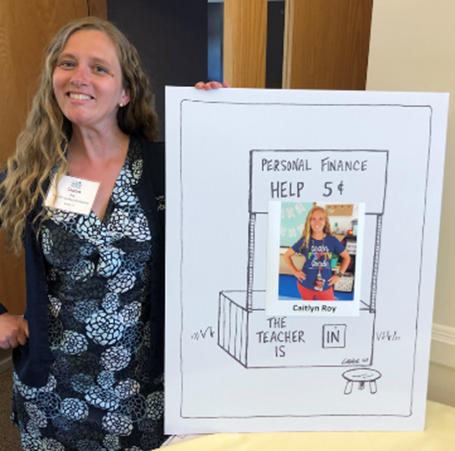
4 Caitlyn Roy J
Caitlyn Roy, 5th grade teacher at Rose M. Gaffney Elementary School in Machias and Maine Jump$tart’s 2021-2022 Financial Educator of the Year

Since its founding, Maine Jump$tart has delivered more than 20 training events for teachers and other professionals working in areas connected to community financial well-being including guidance counselors, social workers, financial aid officers, and school administrators. Another key initiative from Maine Jump$tart has been the Financial Educator of the Year Award, first awarded in 2012. Thanks to many sponsors and volunteers, all these events have been provided at no cost for Maine teachers.

Last month I introduced this blog with the fact that Maine students are not required to take a personal finance course to graduate high school. I also mentioned that despite that truth, personal finance education is happening in Maine, and a significant amount of it has been influenced, inspired, and even created thanks to the outreach of Maine Jump$tart and every conference attendee since 2009.

They are doing this even when the state doesn’t require it, even when it’s hard for schools to find time in the curriculum. They are doing this mostly because they believe in it and because their students and their families tell them it matters.

Maine Jump$tart permanently and positively changed my personal finance teaching at one event in 2010, and in the years since I have tried to pass on that gift by serving on the board, delivering presentations, and listening to what others are doing in their classrooms.

It is indeed a coalition — one made of financial education heroes. Join us for this year’s event and take your program or your vision for a program to the next level.

P.S. Maine Jump$tart was awarded State Coalition of the Year by National Jump$tart for 2023. It is the SECOND time Maine has earned the honor with the other coming in 2013. Not too shabby.

The information in this blog is for general educational and informational purposes only and does not constitute financial, investment, insurance, tax, or legal advice. FAME is not a licensed financial or investment advisor, a licensed insurance agent, a tax accountant or an attorney. 

My name is Steve Kautz, and I am an Accredited Financial Counselor and a Financial Education Specialist at the Finance Authority of Maine (FAME). I visit schools and businesses, deliver webinars, attend events, write, and try just about anything else I (or my boss and colleagues) can think of to promote financial wellness in Maine. Before starting with FAME in July 2023, I taught math, economics, and personal finance for 20 plus years, worked as a training coordinator for the Maine Jump$tart Coalition for Personal Financial Education, and served as a U.S. Peace Corps Volunteer in the Czech Republic ’95-’97.

Joining FAME has been a legitimate career milestone, not simply because it’s a great place to work, with a mission I share, but because it has allowed me the opportunity to join a committed agency and scale my efforts in financial education statewide. FAME’s myriad of resources and programs designed to improve the economic lives of Mainers through business growth and stability, education, and financial capability, enable me to do something I love and believe in every day.

Welcome to my blog and to Financial Literacy Month (yes, it’s a thing, every April).

On December 13, 2023, Pennsylvania became the 25th state to require a standalone personal finance course for high school students. One organization leading the charge is Next Gen Personal Finance (NGPF), and they use the phrase, “guarantees a standalone personal finance course” for high school students. Maine is not one of the 25 states to require or guarantee a standalone personal finance course for high school students. Recent attempts (in the form of LD 1284) at the Legislature to achieve this for Maine high school students have not been successful. 

So, for at least another legislative session or another year (likely more), FAME will keep advocating for Maine’s high school students to have guaranteed access to personal finance education in some form before graduation. 

Randomly selected, but not randomly focused statistics:

  • 88% of American adults surveyed say that personal finance should be a high school graduation requirement (NEFE – National Endowment for Financial Education study, 2022)
  • 60% of US adults are living paycheck to paycheck (Lending Club Corporation, 2023)
  • $152,000 = the total cost of a four-year degree at a public university (Educationdata.org findings, which include lost income opportunity and interest on loans)
  • 18 = the official age when we ask someone to take on the above-mentioned financial decision
  • Credit score… yuck. We all know what it is, and the simple fact it exists and stays with us, like that old pair of shoes you just can’t get yourself to toss, should be enough to make financial education as integral a part of schooling as US history.

So, am I here to convince you that Maine needs to find a way to ensure equal access to financial education? Not really, because I know that, statistically speaking, I am preaching to the choir. 

However, there is a connection.

Right now, in Maine, there are already bunches of teachers teaching personal finance to even bigger bunches of students. This is happening through required classes, electives, seminars, clubs, and competitions. This is happening even though the state doesn’t require it. And behind these teachers there are more teachers and organizations providing training and curriculum support. This is happening because the adults in the room care about giving our kids – our state – a fighting chance out there in the American economic wilderness. 

This blog/newsletter/semi-organized-words-on-your-screen is about personal finance, money, and the need to talk about money. It’s just another small way of promoting financial education in any way I can, one person at a time if necessary, until Maine becomes the 26th state (and even then, I’ll still be fighting to deliver what we promise). 

Let’s Chat

I’m not an expert on building wealth, financial markets, or bond prices. What I am is someone who spent many years making financial mistakes and many more years working to overcome them. Along the way, I started telling my stories and teaching personal finance fundamentals – sometimes teaching what I was still learning myself. I am – I have become – an expert in taking my love for numbers, an understanding gained from my own money mistakes, and my keen eye for economics and turning them into a way to engage my community to navigate the opportunity-filled yet hazard-laden American financial system. 

I’m not here to deliver or teach the details, although I will provide resources to that end. I’m here to push the conversation about personal finance so that Maine’s youth, and ultimately all Mainers, benefit. I want to do this as if we were sitting around a table, coffee in hand, learning from each other.

I’ll tell my stories and offer thoughts on everything from interest to banking to credit cards and more. I’ll ask former students for their stories and how having had personal finance in high school has affected them. I’ll ask you to search for your experiences and get in touch with your own money story.

Join me for a few minutes a month?

When I was in high school, the closest thing we had to a personal finance course was home economics. While I don’t fully trust my memory, I can safely say that some aspects of what we now call personal finance were a part of that course – opening a bank account, balancing a checkbook, tracking expenses, food shopping and meal planning, etc. But in my school (anecdotally speaking in most schools I’ve heard about), it was a course that the girls took while most of the boys took “shop”.  That and the fact that these courses gradually disappeared from many schools are topics for another day.

Whether its home economics or personal finance, it is, ultimately, personal. Our unique experiences are what separate the topic from the bigger world of finance – the one with international trade, currency fluctuations, PE ratios for stocks, bond markets, and other dizzying concepts. 

Our story is the one that matters.

So, I’ll tell you mine (well, just part one for now) if you’ll promise to at least think about yours. It would be even better if you would write yours. I found the experience enlightening, liberating, emotional, and satisfying.

It was 1974, and I was the youngest paper boy in the state. Every morning, I hit the streets of Derby, Connecticut, sometimes in the dark, sometimes on my bike, sometimes in the car with mom, but most often alone. I made my rounds, placing the rolled up New Haven Register papers inside screen doors or dropping them in mailboxes. I delivered to houses, pizza places, and law offices in brick buildings with huge wooden doors. Once every two weeks, in the afternoons, I made my collections, took home the 20 or 30 envelopes, and laid them on the kitchen table. I reconciled my receipts, calculated what I owed the company, counted my profits, and figured how much I could put into my savings account. I was nine years old. When I was 12, I would turn much of those savings into my first major purchase – a Radio Shack stereo, along with a few of the best rock albums of 1977 including Point of No Return, Book of Dreams, and The Grand Illusion. What a system: work, earn, save, spend, repeat.

On the mornings when mom drove me – either because of weather or because I was nine – we somehow found time to stop at Dunkin’ Donuts. Mom got a black coffee and we both got double chocolate donuts. I remember one morning, after I’d had the paper route for a few months, when I paid. I couldn’t get the money out of my little change pocket fast enough. I still choose the double chocolate donut when I go to The Dunkin’, and I think of those mornings with mom. 

I got my first credit card at 20, and by the time I was 25, I had at least seven or eight, each carrying balances of several hundred dollars or more. The system had changed. Work, earn, spend more than you earn, pay interest, work even more to pay for it all, repeat. By 27, I was caught in a dismal cycle. My job paid well, but I hated it. I needed that job because my obligations had grown along with – no, grown faster than – my income, and I couldn’t match it doing something I wanted to do. I was on a treadmill that was outrunning me, and with each day I saw that my job was sometimes contributing to others’ treadmills. I soon found myself looking beyond that misery and reaching for the philosophical. What happened to the paper boy? What kind of system is this? How do I get out?

Edge of your seat, I know. Spoiler alert – I did climb out of that mess and have gradually found firmer financial ground. However, that rough start was expensive, and I’m still paying in terms of opportunity cost. Let’s just say that my expected retirement age went up while my lifestyle options while retired…yep, they’ve gone the other direction.

Not only do our stories matter, but they are also incredibly effective when teaching personal finance. In my experience, students are more likely to listen to and put into practice financial education when the messages have a face and feel real. It’s no different than that history teacher (I think most of us had one) who used stories to make past events and people relatable and interesting. This is the core reason why someone like Dave Ramsey has built a “money-talk” empire – he teaches from vulnerability, failure, and rebuilding.

We want our students to remember our lessons and messages. Stories and humor are emotional. Emotion prints memory. You can use your personal lessons and/or help students connect with and tell their own stories about money. This can highlight their experience so far or can help them explore what they want their personal finance story to be. I used to add an alternative project or supplement to writing a personal finance story – a personal finance road map – where students could make a poster-like project showing stages of their life and where and how money fits into their life experiences, goals, and dreams.

I know a few people who seem to have never made mistakes with money. I know a few more who have enough wiggle room to make mistakes with a capital $ on the end. However, most people I know (and, statistically speaking, the vast majority of Americans), have tripped and fallen and continue to stumble on their personal financial journey.

This former financially savvy paper boy turned wallet-full-of-plastic guy got to work on getting it right when I faced up to the reality of where my money behavior was taking me. The biggest steps I made along the way came when I dug into and learned from my mistakes, when I understood my story. 

I hope you’ll dig into yours.

Seville, Spain, sometime in 2018, English conversation class for college students. The topic: money.

“Credit score, credit bureaus… Oh boy, it’s tough to translate something that doesn’t exist in Spain. In fact, nearly all of Europe and most of the world do not use credit scores and don’t have centralized credit reporting agencies,” I told this class, as I had told many before, both in Spain and the Czech Republic.

“Can you explain it to us?” they asked.

“I’m not sure, but I will enjoy trying,” I replied, wondering if they had seen Fight Club

The American economic system is complicated (in casual conversations a stronger adjective is needed), and navigating our system when it comes to personal finance is complicated times ten. This is true in a vacuum and is especially obvious when compared to other countries. Yes, “land of opportunity” still rings true, and I say that after living abroad for 10 years and having taught students from more than a dozen countries. But the costs of that opportunity (sweet economics pun for anyone paying attention to such things) are the sometimes mile-high and spiky hoops we must jump through to get to, and maintain, those opportunities.

What makes it complicated? Hmm… Let me see if I can think of a few things: 

  • Credit scores 
  • The cost of higher education and student loans
  • Relatively easy access to credit
  • Predatory lending, check-cashing businesses, rent-to-own, etc.
  • Health care costs and access to affordable insurance
  • Social security
  • The national debt
  • The non-stop marketing machine that drives consumer society

Exhale. I realized I was holding my breath as I was typing. I further realized that I’d better stop there so as not to turn the whole blog into a list.

Oops, I can’t leave this one off the list: a lack of financial education to help face those challenges.

I can’t say these issues don’t exist in other countries. But I can say from personal experience and research that Nobody Does it Better than US, and “better” in this case is not always a good thing. Yet even with those challenges, America is still near the top of any list in terms of personal economic opportunity.

Has it always been so tough? In some ways it was certainly tougher on Americans before stronger labor laws, social security, banking regulations, and relative progress towards economic equality for all regardless of gender, race, or ethnicity. But some things have gotten worse, or are relatively new problems, such as easy access to credit and the consequences it brings. Statistics on credit card use and debt are easy to find and understand, but not easy to put into perspective. One thing is clear: in 1970, less than 50% of Americans had a credit card, and now it’s over 90%. Yes, convenience and technology are a part of that, and some of the side effects of credit card use are objectively good (safety compared to cash, cross-marketing benefits, etc.).

All Together Now

The connection to the complicated American financial system is that when it’s so easy to get credit, it’s so easy to misuse it, pile up debt, and make a real financial mess. Yet, as a nation, we allow our 18-year-olds into this system without the educational foundation (a shield) to understand and protect against the double-edged sword of compound interest. 

The generations responsible for allowing financial education to be largely ignored have an excuse; it wasn’t that long ago that credit cards were not easily available, people got jobs that they kept for 30 or 40 years which provided health care and pensions, a college degree was not in as high demand or as expensive (adjusted for inflation), there were no 72-month, $40,000 car loans, and our life expectancy was not a decade or more longer than our career expectancy.

It’s no one’s fault that it’s so tough out there. Our society and its unprecedented economic experiment have evolved, and there is plenty of good in that evolution. It will be everyone’s fault, however, if we don’t catch up and better prepare our new adults to step into the financial funhouse that we call American capitalism.

So, I ask myself again today, “What can I do to help one student, one class, one person, not only survive our system but learn to thrive in it?” Won’t you join me?