



Tax Return Gymnastics
There are a lot of moving parts in the income tax machine. There is the W-4 form, which we fill out when we start a job and/or when we need to make changes in our tax withholding. There are tax brackets, tax credits, tax deductions, and so on and on and on and… Did you know that the US tax code including all IRS laws and guidance is around 70,000 pages long?
Then there is the tax return. Federal, of course, for everyone, and there are state income taxes in 41 states. And there are also cities that have their own income tax. It can be challenging to manage. A synonym for challenging is taxing. So, yes, one can say that dealing with taxing is… Taxing. I checked—there are no penalties for puns in personal finance blogs!
Ultimately, when the year ends and the tax returns are done, we either owe, break even, or get money back. Any of those results can be desirable depending on, at a minimum, the factors mentioned above as well as plenty of other considerations.
A job change or an income change? Time to fill out/update a W-4. Imagine a point in late 2023.
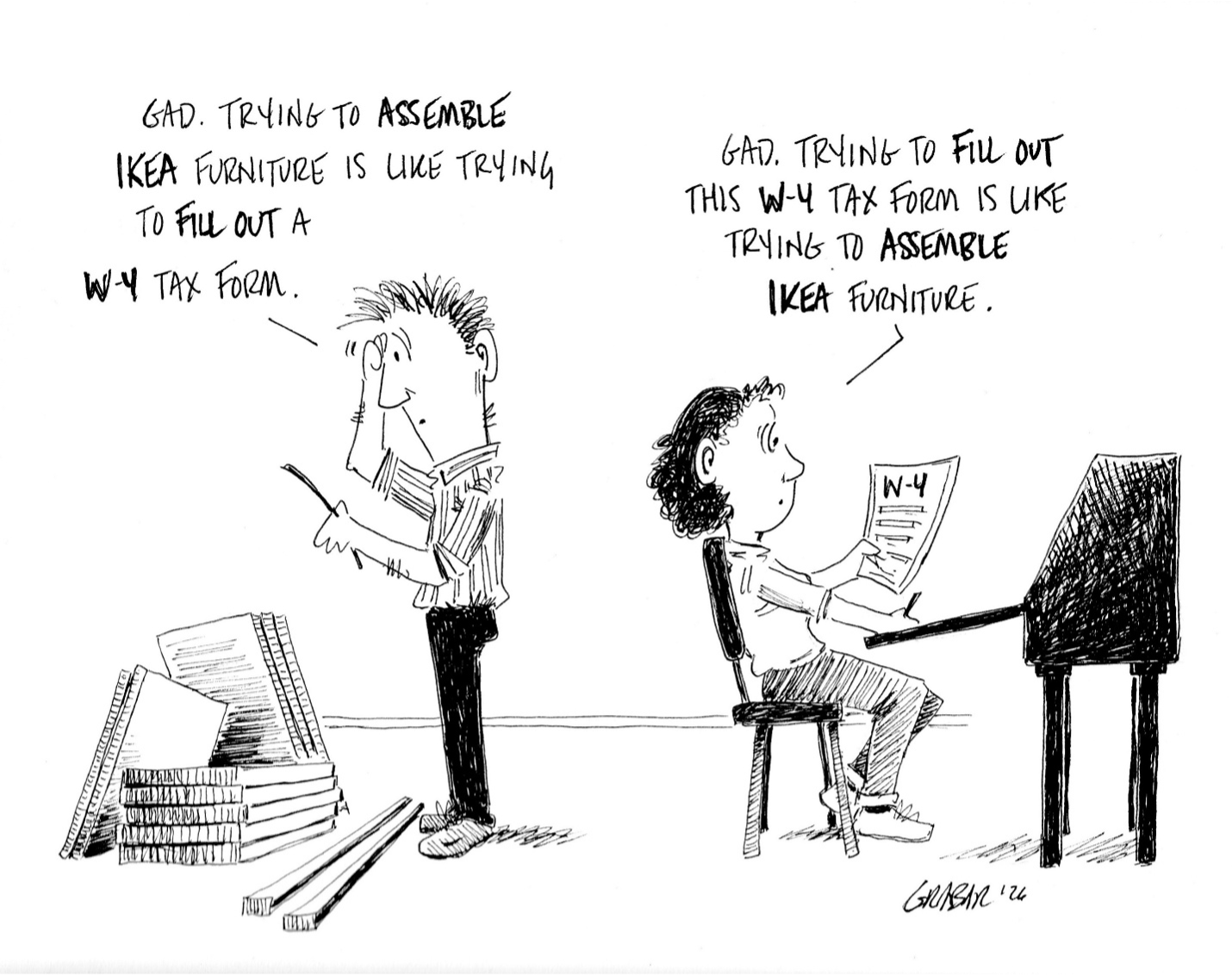
Ok, let’s take a new look at the good old W-4 form so I can set my tax withholdings. It says here, “Complete this step if you (1) hold more than one job at a time, or (2) are married filing jointly and your spouse also works. The correct amount of withholding depends on income earned from all of these jobs.”
Well, that sounds simple enough, but wait, what’s this? “If you have two jobs or you’re married filing jointly and you and your spouse each have one job, find the amount from the appropriate table.” Oh no, I’m not going to get this right.
Filing the 2024 tax return—now it’s April 2025.
Possibility #1: Just filed my taxes, and yes, please, I’ll take that fat tax refund!
Possibility #2: Just filed my taxes, and I owe, I owe, so back to work (on my W-4) I go.
Possibility #3: Just filed my taxes, and it was just right.
My most recent W-4 experience resulted in possibility #2—I owed a bunch in state and federal income tax. What about you? Big return? Big tax bill? Even Stephen? And what did you do as a result? Let’s look closer at the first two outcomes.
The Big, Spendable, Tax Refund—A Good Thing?
It’s impossible to define a “big return” across the board, so let’s agree that it’s subjective, and that if it’s a significant amount of money to you, then it counts. By the way, the average return for 2025 was around $3,500 (as of April 1st), which is nearly 11% higher than 2024 (attributed to changes in tax laws, especially the standard deduction).
$3,500 always sounds nice but is it when it comes in the form of a federal tax refund?
Considerations include:
- It isn’t new or found money. It’s your money that you in effect lent to the federal government for the tax period—and you lent it without charging interest. Putting the philosophical aside, this situation is a financial loss.
- An alternative is to adjust your withholding so that less money comes out of each paycheck and therefore lands in your bank account sooner. That would allow you to spend the money as needed or stash it away and earn interest. How much would you earn? Of course, that depends on your bank, the type of account, and other factors such as risk. But it could be earning or helping you address wants and needs throughout the year rather than through the tax refund. Making this change means filling out a new W-4. Check with your employer on the process and see the resource list for more.
- On that pesky other hand, sometimes we are not so disciplined with a little extra cash coming in weekly or monthly and it tends to evaporate through the holes in our budgets. Therefore, the government holding our money for us can act as a kind of forced savings.
- Instead of changing your withholding, another way to attack the more money in each paycheck situation is to set up a direct deposit from your paycheck or from your principal bank account into a different, dedicated bank account, helping you to pay yourself first and automate your savings.
Making the Most out of a Tax Refund
Options to Consider:
- Pay down or payoff debt
- Contribute to an education savings account or a retirement account
- Make an extra mortgage payment
- Start or add to a “next car” fund
- Pay cash for an immediate or upcoming need such as an appliance
- Build the emergency fund
- Use the money for a want, enjoy it, and avoid paying for that want via credit card or through other loans.
Owing Money at Tax Time
The first thing to decide is whether the amount you owe is an acceptable trade-off for having extra money each pay period rather than building it up towards a tax refund. And just like the refund, the idea of, “How much is too much” is up to every individual to decide (be aware and beware of potential penalties for not having enough tax withheld—see IRS rules).
- If you are not ok with how much you owe, then it’s time to do a new W-4 and adjust withholdings.
- If the amount you owe has really caught you off-guard, and you can’t pay all at once, talk to the IRS about a payment plan. Be sure to file your taxes or at least file for an extension—penalties for not filing are typically more severe than fees or penalties incurred for paying late or through a payment plan.
Maintaining the Income Tax Balance
The tax return is a reconciliation of taxes paid throughout the year versus what should have been paid. For most workers, this process starts when we fill out that W-4 form for a new job, but it doesn’t end there. Those 70,000 pages of IRS tax code have something in store for all of us, and there are endless scenarios which affect how much we actually pay in income tax. So, just like reviewing budgets and insurance coverages, it is important to our overall financial wellness. It’s critical to keep an eye on that income tax balance and adjust (usually via the W-4 form and our employer) as needed if the tax return results are not in line with your financial goals.
About the Author:
Steve has worked on financial literacy efforts in Maine since 2004, and in July 2023 he started at FAME as a Financial Education Programs Specialist. He is an Accredited Financial Counselor (AFC®), a WISE-Certified Personal Finance Educator, has a B.S. in economics from Southern Connecticut State University, an MBA from the University of Hartford, and served as a U.S. Peace Corps Volunteer.
In the fall of 2003, he started a 20-year connection to the Waynflete School in Portland, where he taught math and personal finance, advised middle and upper school students, and coached baseball. Steve worked with students to create the Finance Club and an award-winning LifeSmarts team (Nationals 2013, 2014, and 2015). In 2011, Steve coached a Waynflete team to victory in the Boston Federal Reserve Economics Cup Challenge.
Steve was named Maine Jump$tart Financial Educator of the Year for 2012, was the keynote speaker at the Maine Jump$tart Annual Teacher Conferences in 2015 and 2023, and was Maine Jump$tart’s training coordinator from 2017 to 2023.
Steve and his family moved to Seville, Spain in July 2016 where he taught English and business English and learned many new personal finance lessons. He now lives in Portland with his wife and their son.