


About a year ago we released the first post for this blog, and I’m still here, 15 posts older and more eager than ever to keep the conversation going. In those 15 posts, I touched on economics, the monthly payment mindset, budgeting, financial aid for education, personal finance terminology, insurance, reflection on my own… Uh… Experiences (mistake$), and more.

I’ll call this an accomplishment, but I’ll also note that during the past year the list of topics I still need to write about has grown. Yes, there is much to discuss, much to share, much to learn.

Financial Literacy Month

Despite the fact that it is snowing as I’m blogging, April is back, and in FAME’s world that means, among other things, Financial Literacy Month. It’s a time when organizations, educators, and financial professionals everywhere in the US are promoting the importance of financial capability. Here’s a sample of what’s going on right here in Maine.

Events, initiatives, and resources:

  • Educator’s conference: Maine Jump$tart’s 16th Annual Fostering Financial Education in Maine Schools  Conference will be held May 8-9 in Portland. This year’s event is unique as the May 8th portion is being brought to us by VISA and the Council for Economic Education, who have put together an incredible day of training and fun including meals and a sunset cruise in Casco Bay. There is still time to register!
  • For kids: FAME’s first-ever Design Your Own Dream Money contest is underway. This is for all Maine students in grades 1-6, and submissions will be accepted until April 30.
  • Could it be? Personal finance becoming a graduation requirement in Maine? Well, maybe not yet, but efforts are underway during this legislative session to once again bring the conversation forward. The first hearing took place on April 1, 2025; read more about the bill.
  • A FREE summer course for high school students: FAME’s 2025 Personal Finance Summer Institute is happening July 21-25 in Portland, and registration is open.
  • More from FAME: Resources to help you celebrate and promote Financial Literacy Month

It’s not just snowflakes falling

I’m not writing in a vacuum; therefore, I can’t go on without acknowledging the stock market-related pain that has been April, so far.

It’s been hard to watch, and depending on where you are on a scale of 20-something to retired, you might not want to watch, at least in the short-run. From an educational perspective, it’s critical to understand the history of stock market movements and the basis for its relative long-term success.

The stock market is ultimately based on the performance of an incredibly wide range of companies that produce and sell everything we consume. Our economy runs like no other, we consume like no others, and as a result, those companies make (and distribute back to stockholders) steady and substantial profits. This fact is, it’s not going to change based on anything that has happened or is likely to happen to our economy in 2025.

Yes, we are in or close to what is known as “correction” territory. However, “Corrections in the stock market are pretty standard fare. There have been 21 declines of 10% or more in the S&P 500 since 1980, with an average intra-year drawdown of 14%,” according to Baird Private Wealth Management. (cnbc.com)

If you are using your investments now or expect to be soon, you might need to consult a professional before taking action. But for most investors most of the time, don’t just do something, stand there! Warren Buffet knows a little about stocks and has been known to offer on-the-money advice. One of his favorite lines comes from a 19th-century poem by Rudyard Kipling; “If you can keep your head when all about you are losing theirs… If you can wait and not be tired by waiting… If you can think—and not make thoughts your aim… If you can trust yourself when all men doubt you… Yours is the Earth and everything that’s in it.”

Back to Financial Literacy Month

Once again, money lists are everywhere, and I do like a good list. I’m referring to the personal finance type – things to do, think about, start, finish, check on, cut back, increase, and just about any other verb you can connect to managing money.

I’ve perused these for weeks, boiled it all down, and have come up with my own – a Top 14 money-related menu for Financial Literacy Month.

Why 14? Because I don’t think I’ve ever seen a Top 14 list. Or we can consider it inflation’s effect on Letterman.

Top 14 Personal Finance Items Checklist for Financial Literacy Month 2025 (in no particular order, although I will highlight my personal Top 3 for 2025)

  1. Create/Update Budget
  2. Build/Reinforce Emergency Fund
  3. Payoff/Pay Down Short-Term Debt
  4. Prioritize Retirement Plan
  5. Insurance Check-up
  6. Boost Automated Saving/Investing
  7. Increase Education Savings
  8. Check Your Credit Report
  9. Work on Your Credit Score
  10. Set Goals
  11. Check Your Tax Withholdings
  12. Develop Buyer’s Remorse – BEFORE Buying!
  13. Internet/Technology & Financial Security Checkup
  14. Talk with Children about Money

An interesting thing I’ve noticed – when you work on one of these, others are often affected, like dominoes falling in the right direction. For example, by checking on insurance, you might change your deductibles, save $120/year, and redirect that money into building an emergency fund or into boosting savings. By paying off debt you can increase your credit score, which has benefits ranging from lower mortgage interest to better car insurance rates. So even if you can only directly work on one

And the list(s) go on and on… Like I said in that first post a year ago (yes, I say it a lot), our financial system is complicated, slippery, and difficult to navigate. It takes constant vigilance and learning to give order to all things money.  

So, think about what Financial Literacy Month means to you? Attack a piece from that list or from others’ lists and give your future self the gift of good money decisions today.

“Kids these days.” – said by everyone who is not a kid, in every decade since the beginning of kids.

A funny thing has happened to me during the decades that I’ve been working on personal finance – both as a teacher and a learner – I’ve gotten older! And despite my youthful glow, I now know what curmudgeon means. Sigh. But over the years I have tried to push back against the notion that younger generations just don’t understand – anything – whether it’s clothing styles, language use, or money habits.

It turns out that folks of certain ages have been trying to explain the generation gap for a very long time.

“They [Young People] have exalted notions, because they have not been humbled by life or learned its necessary limitations; moreover, their hopeful disposition makes them think themselves equal to great things – and that means having exalted notions. They would always rather do noble deeds than useful ones: Their lives are regulated more by moral feeling than by reasoning – all their mistakes are in the direction of doing things excessively and vehemently. They overdo everything – they love too much, hate too much, and the same with everything else.”

Hinton, Kerouac, or Freud, you say? Nope, go back just a bit further.

Aristotle. Yes, 23 centuries ago Aristotle.


And examples of “Young People” doing amazing things, smart things, wise things, are all around us. This past fall I had the wonderful experience of teaching a personal finance course, Money Matters, at the Maine College of Art & Design (MECA&D), and along the way I got to work with one of these young stars, one who happens to be pursuing unicorn status as an artist and a personal finance expert.

I’d like to introduce Jaden Kyung-Moon Bauch, a current student at MECA&D and my TA for the Money Matters course this past semester. Jaden is 21 years old, will graduate from MECA&D in May with a Bachelor of Fine Arts in Painting with a Minor in Art and Entrepreneurship, has passed both the Securities Industry Essentials Exam and the Series 65 (Uniform Investment Adviser Law Exam), and has already learned as much about personal finance as almost anyone I know.

What was the moment or turning point that got you interested in personal finance?

In my sophomore year at MECA&D, I had to get a root canal, and I didn’t have dental insurance. The procedure cost over $4,000, and I simply didn’t have that kind of money. I remember when my checking account balance was negative $500. At the same time, my student loan balance kept climbing higher and higher, and I couldn’t see a financially stable future for myself after graduation. I felt like choosing a creative career meant I was destined to have less financial success than others. But I decided I wasn’t going to accept that. That’s when I started self-studying personal finance, and I realized that financial literacy wasn’t just a tool for managing money—it was a tool for regaining my confidence and taking control of my future. That realization led me to want to help others, especially artists, understand and achieve their own financial goals.

How has your increased financial education affected your college experience?

Without a doubt, increasing my financial education has significantly improved my college experience. Not only did I gain a passion and a mission, but having greater financial literacy ultimately allowed me to spend less money, make more money, and do more with it.

I also think people—especially those my age—underestimate how much financial stress weighs on their subconscious. Even if you’re not actively thinking about money, it still takes up space in your brain. But when you take control of your finances, gain confidence in your financial situation, and understand how money supports your life, a huge weight lifts off your shoulders—one you may not have even realized was there.

What are some financial challenges unique to working artists?

The biggest hurdle for artists isn’t just financial logistics such as accounting and retirement—it’s overcoming the starving artist narrative.

When you tell someone you want to be an artist, their first thought usually isn’t that you’ll be financially successful—they might even try to talk you out of it. Somewhere along the way, choosing a career in art became synonymous with choosing financial insecurity.

This mindset is incredibly discouraging. If all you ever hear is that you’re going to struggle or fail, it becomes that much harder to succeed. The starving artist narrative actively holds creative people back—not just from pursuing their financial goals, but sometimes from pursuing a creative career altogether. All too often, the stories that get amplified are those of artists who only found success after their death, artists who ended up homeless, or art school graduates who stopped making art entirely a decade later. 

Have you had the chance at MECA&D to pass on some of what you’ve learned?

Yes! I’ve had many opportunities to do so. One example was, of course, in Money Matters, where I was able to cover certain classes and contribute support in areas where I had a specialized knowledge base. I also had the opportunity to speak to the Fine Art seniors— those in sculpture, painting, photography, and printmaking— focusing on budgeting, credit, and investing.

On another occasion, I gave a lecture to the entire freshman class about personal finance for artists. Most recently, my senior thesis focuses on equipping artists with the financial tools they need to thrive. As part of my thesis, I offer free financial coaching to artists and creative professionals, using those coaching sessions as inspiration for my paintings.

I also operate a resource on Instagram called The Financial Palette, which focuses on bite-sized finance and business tips for young creatives. My goal this year is to elevate this to the next level and expand beyond Instagram.

While working with you last semester, I noticed that your views on money and investing are “old school”. I think that’s a good thing. How did someone from your generation connect with those values?

It’s probably natural to develop those kinds of values when most of the finance books I’m reading are written by people four times my age—haha. I suppose you’re right, some of my beliefs are a bit old-school. I tend to favor simple strategies like passive investing and the three-fund portfolio. I also try to avoid finance discussions on social media unless they’re coming from qualified financial professionals because there’s a lot of misinformation out there, particularly around investing. So many people are just trying to sell day trading courses.

When it comes to investing and personal finance, you should stay with the times, but I don’t think you need to reinvent the wheel. Yes, you can be creative and tailor strategies to fit your unique situation, but that’s completely different from using approaches that have no quantitative backing.

I try to approach discussions about finance with those in my age group from a “modern” perspective because things are so different now compared to when our parents were our age. I focus more on mindset and developing strong financial habits—because I believe that’s the foundation of financial success, whatever that may look like for you.

What are your career goals?

Some people think I’m dreaming, but I have an elaborate plan for my career.

Within the next 2 years, I hope to complete the education requirements, pass the Certified Financial Planner (CFP) exam, and gain the necessary hours to earn my certification. From there, I’d like to spend three to five years working in the industry, gaining experience and expertise.

After that, my goal is to start my own financial services firm dedicated to serving creative professionals. I want it to go beyond just financial planning because there are so many other areas—like financial coaching, business planning, and tax preparation—that play a crucial role in a holistic financial strategy.

How do you see your art fitting into your professional life after college?

This question comes at a great time, as it’s something I’ve been thinking about a lot while navigating my thesis. I see art remaining a significant part of my life. I’ll continue attending gallery openings and staying engaged with the art world. However, when it comes to my own studio practice, I’m not entirely sure what that will look like long term.

There may come a time when I must choose between pursuing my dream of owning a financial services firm and being a practicing painter. While I love painting, I believe I can provide more value to the creative community through my financial expertise. However, in many ways, my art serves as a gateway to conversations about my mission. I especially enjoy projects where I can sell my work and use the proceeds to support artists.

Top personal finance advice for your generation?

1. Invest in yourself more than the average person.

2. Ultimately, your ability to be financially successful isn’t determined by your age, gender, race, career, or socioeconomic status—it’s determined by you.


Like I said, “Kids these days… are awesome.” Thank you, Jaden.

The following sounds like one big, loud, and proud advertisement for Maine Jump$tart and the educators who are bringing personal finance education to Maine students.

It is.

They are among Maine’s many financial education champions and heroes, and they are making a difference.

Way Back to May 7, 2010 – Augusta Civic Center

This day marked THE turning point for me as a personal finance teacher. It was also a big day for The Maine Jump$tart Coalition for Personal Financial Literacy.

It was the group’s first Annual Fostering Financial Education in Maine Schools Conference, and it inspired and empowered me to take my efforts in teaching personal finance to another level. Fast forward 15 years to May 17, 2024, and Maine Jump$tart will be putting on the 15th iteration of this annual event. Along the way, these trainings have reached hundreds of Maine teachers and community educators who have taught and influenced thousands of Maine students.

Jump$tart Me Up

Prior to this event, I had already converted two math electives at my school into a fall offering called, “Business and Finance”, and a spring course, “Personal Finance”. I covered key economics topics and banking in the fall; balancing checkbooks, insurance, credit score, etc. in the spring. Somewhere around eight to ten seniors (out of a class of 60) were taking the elective. (Enrollment would triple in just a few years.)

Then, at the May 7th event in 2010, this happened:

  • I heard former Governor Angus King speak about the importance of financial education.
  • I learned about SIFMA’s Stock Market Game.
  • I met folks from The Federal Reserve Bank of Boston.
  • I learned about and eventually attended a unique teacher training event at The New York Stock Exchange.
  • I spoke with other educators from around Maine and heard about what they were doing in the classroom.

I drank from the fire hose, and it was wonderfully overwhelming!

I went back to the classroom and for the rest of the summer, I chipped away at revamping my courses. Here is just a sample of what I added for the following school year:

  • The Stock Market Game
  • A several-week-long budgeting spreadsheet exercise
  • A unit on credit score
  • Increased focus on how the Federal Reserve’s role in the banking system affects consumers
  • Games, web tools, and lesson plans
  • I worked with students to start a Finance Club and to form a team for the Boston Federal

And that was all just from the first year of attending the conference. I’ve attended almost every conference since, helped to plan and deliver a few, and along the way, I learned about FAME. And yes, that has turned out to be a big deal for me.

The Maine Jump$tart Coalition for Personal Financial Literacy was founded in 2008 as an affiliate of the National Jump$tart Coalition, with a mission “to improve the financial knowledge of Maine citizens, with a special focus on pre-K through college-aged students, including adult learners.”

4 Caitlyn Roy J
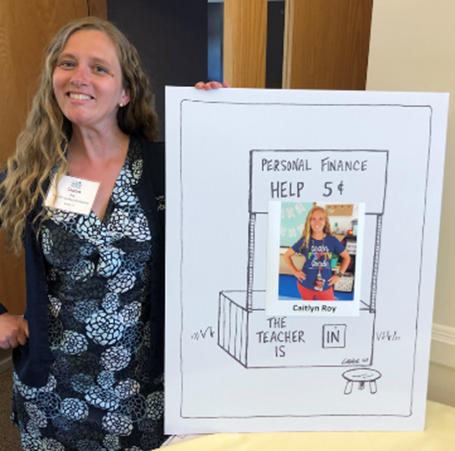
Caitlyn Roy, 5th grade teacher at Rose M. Gaffney Elementary School in Machias and Maine Jump$tart’s 2021-2022 Financial Educator of the Year

Since its founding, Maine Jump$tart has delivered more than 20 training events for teachers and other professionals working in areas connected to community financial well-being including guidance counselors, social workers, financial aid officers, and school administrators. Another key initiative from Maine Jump$tart has been the Financial Educator of the Year Award, first awarded in 2012. Thanks to many sponsors and volunteers, all these events have been provided at no cost for Maine teachers.

Last month I introduced this blog with the fact that Maine students are not required to take a personal finance course to graduate high school. I also mentioned that despite that truth, personal finance education is happening in Maine, and a significant amount of it has been influenced, inspired, and even created thanks to the outreach of Maine Jump$tart and every conference attendee since 2009.

They are doing this even when the state doesn’t require it, even when it’s hard for schools to find time in the curriculum. They are doing this mostly because they believe in it and because their students and their families tell them it matters.

Maine Jump$tart permanently and positively changed my personal finance teaching at one event in 2010, and in the years since I have tried to pass on that gift by serving on the board, delivering presentations, and listening to what others are doing in their classrooms.

It is indeed a coalition — one made of financial education heroes. Join us for this year’s event and take your program or your vision for a program to the next level.

P.S. Maine Jump$tart was awarded State Coalition of the Year by National Jump$tart for 2023. It is the SECOND time Maine has earned the honor with the other coming in 2013. Not too shabby.