


The following sounds like one big, loud, and proud advertisement for Maine Jump$tart and the educators who are bringing personal finance education to Maine students.

It is.

They are among Maine’s many financial education champions and heroes, and they are making a difference.

Way Back to May 7, 2010 – Augusta Civic Center

This day marked THE turning point for me as a personal finance teacher. It was also a big day for The Maine Jump$tart Coalition for Personal Financial Literacy.

It was the group’s first Annual Fostering Financial Education in Maine Schools Conference, and it inspired and empowered me to take my efforts in teaching personal finance to another level. Fast forward 15 years to May 17, 2024, and Maine Jump$tart will be putting on the 15th iteration of this annual event. Along the way, these trainings have reached hundreds of Maine teachers and community educators who have taught and influenced thousands of Maine students.

Jump$tart Me Up

Prior to this event, I had already converted two math electives at my school into a fall offering called, “Business and Finance”, and a spring course, “Personal Finance”. I covered key economics topics and banking in the fall; balancing checkbooks, insurance, credit score, etc. in the spring. Somewhere around eight to ten seniors (out of a class of 60) were taking the elective. (Enrollment would triple in just a few years.)

Then, at the May 7th event in 2010, this happened:

  • I heard former Governor Angus King speak about the importance of financial education.
  • I learned about SIFMA’s Stock Market Game.
  • I met folks from The Federal Reserve Bank of Boston.
  • I learned about and eventually attended a unique teacher training event at The New York Stock Exchange.
  • I spoke with other educators from around Maine and heard about what they were doing in the classroom.

I drank from the fire hose, and it was wonderfully overwhelming!

I went back to the classroom and for the rest of the summer, I chipped away at revamping my courses. Here is just a sample of what I added for the following school year:

  • The Stock Market Game
  • A several-week-long budgeting spreadsheet exercise
  • A unit on credit score
  • Increased focus on how the Federal Reserve’s role in the banking system affects consumers
  • Games, web tools, and lesson plans
  • I worked with students to start a Finance Club and to form a team for the Boston Federal

And that was all just from the first year of attending the conference. I’ve attended almost every conference since, helped to plan and deliver a few, and along the way, I learned about FAME. And yes, that has turned out to be a big deal for me.

The Maine Jump$tart Coalition for Personal Financial Literacy was founded in 2008 as an affiliate of the National Jump$tart Coalition, with a mission “to improve the financial knowledge of Maine citizens, with a special focus on pre-K through college-aged students, including adult learners.”
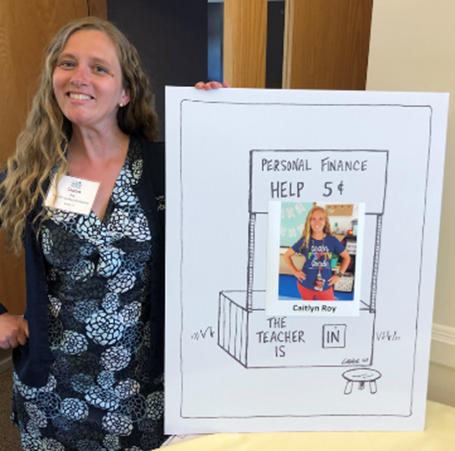
4 Caitlyn Roy J
Caitlyn Roy, 5th grade teacher at Rose M. Gaffney Elementary School in Machias and Maine Jump$tart’s 2021-2022 Financial Educator of the Year

Since its founding, Maine Jump$tart has delivered more than 20 training events for teachers and other professionals working in areas connected to community financial well-being including guidance counselors, social workers, financial aid officers, and school administrators. Another key initiative from Maine Jump$tart has been the Financial Educator of the Year Award, first awarded in 2012. Thanks to many sponsors and volunteers, all these events have been provided at no cost for Maine teachers.

Last month I introduced this blog with the fact that Maine students are not required to take a personal finance course to graduate high school. I also mentioned that despite that truth, personal finance education is happening in Maine, and a significant amount of it has been influenced, inspired, and even created thanks to the outreach of Maine Jump$tart and every conference attendee since 2009.

They are doing this even when the state doesn’t require it, even when it’s hard for schools to find time in the curriculum. They are doing this mostly because they believe in it and because their students and their families tell them it matters.

Maine Jump$tart permanently and positively changed my personal finance teaching at one event in 2010, and in the years since I have tried to pass on that gift by serving on the board, delivering presentations, and listening to what others are doing in their classrooms.

It is indeed a coalition — one made of financial education heroes. Join us for this year’s event and take your program or your vision for a program to the next level.

P.S. Maine Jump$tart was awarded State Coalition of the Year by National Jump$tart for 2023. It is the SECOND time Maine has earned the honor with the other coming in 2013. Not too shabby.

When I was in high school, the closest thing we had to a personal finance course was home economics. While I don’t fully trust my memory, I can safely say that some aspects of what we now call personal finance were a part of that course – opening a bank account, balancing a checkbook, tracking expenses, food shopping and meal planning, etc. But in my school (anecdotally speaking in most schools I’ve heard about), it was a course that the girls took while most of the boys took “shop”.  That and the fact that these courses gradually disappeared from many schools are topics for another day.

Whether its home economics or personal finance, it is, ultimately, personal. Our unique experiences are what separate the topic from the bigger world of finance – the one with international trade, currency fluctuations, PE ratios for stocks, bond markets, and other dizzying concepts. 

Our story is the one that matters.

So, I’ll tell you mine (well, just part one for now) if you’ll promise to at least think about yours. It would be even better if you would write yours. I found the experience enlightening, liberating, emotional, and satisfying.

It was 1974, and I was the youngest paper boy in the state. Every morning, I hit the streets of Derby, Connecticut, sometimes in the dark, sometimes on my bike, sometimes in the car with mom, but most often alone. I made my rounds, placing the rolled up New Haven Register papers inside screen doors or dropping them in mailboxes. I delivered to houses, pizza places, and law offices in brick buildings with huge wooden doors. Once every two weeks, in the afternoons, I made my collections, took home the 20 or 30 envelopes, and laid them on the kitchen table. I reconciled my receipts, calculated what I owed the company, counted my profits, and figured how much I could put into my savings account. I was nine years old. When I was 12, I would turn much of those savings into my first major purchase – a Radio Shack stereo, along with a few of the best rock albums of 1977 including Point of No Return, Book of Dreams, and The Grand Illusion. What a system: work, earn, save, spend, repeat.

On the mornings when mom drove me – either because of weather or because I was nine – we somehow found time to stop at Dunkin’ Donuts. Mom got a black coffee and we both got double chocolate donuts. I remember one morning, after I’d had the paper route for a few months, when I paid. I couldn’t get the money out of my little change pocket fast enough. I still choose the double chocolate donut when I go to The Dunkin’, and I think of those mornings with mom. 

I got my first credit card at 20, and by the time I was 25, I had at least seven or eight, each carrying balances of several hundred dollars or more. The system had changed. Work, earn, spend more than you earn, pay interest, work even more to pay for it all, repeat. By 27, I was caught in a dismal cycle. My job paid well, but I hated it. I needed that job because my obligations had grown along with – no, grown faster than – my income, and I couldn’t match it doing something I wanted to do. I was on a treadmill that was outrunning me, and with each day I saw that my job was sometimes contributing to others’ treadmills. I soon found myself looking beyond that misery and reaching for the philosophical. What happened to the paper boy? What kind of system is this? How do I get out?

Edge of your seat, I know. Spoiler alert – I did climb out of that mess and have gradually found firmer financial ground. However, that rough start was expensive, and I’m still paying in terms of opportunity cost. Let’s just say that my expected retirement age went up while my lifestyle options while retired…yep, they’ve gone the other direction.

Not only do our stories matter, but they are also incredibly effective when teaching personal finance. In my experience, students are more likely to listen to and put into practice financial education when the messages have a face and feel real. It’s no different than that history teacher (I think most of us had one) who used stories to make past events and people relatable and interesting. This is the core reason why someone like Dave Ramsey has built a “money-talk” empire – he teaches from vulnerability, failure, and rebuilding.

We want our students to remember our lessons and messages. Stories and humor are emotional. Emotion prints memory. You can use your personal lessons and/or help students connect with and tell their own stories about money. This can highlight their experience so far or can help them explore what they want their personal finance story to be. I used to add an alternative project or supplement to writing a personal finance story – a personal finance road map – where students could make a poster-like project showing stages of their life and where and how money fits into their life experiences, goals, and dreams.

I know a few people who seem to have never made mistakes with money. I know a few more who have enough wiggle room to make mistakes with a capital $ on the end. However, most people I know (and, statistically speaking, the vast majority of Americans), have tripped and fallen and continue to stumble on their personal financial journey.

This former financially savvy paper boy turned wallet-full-of-plastic guy got to work on getting it right when I faced up to the reality of where my money behavior was taking me. The biggest steps I made along the way came when I dug into and learned from my mistakes, when I understood my story. 

I hope you’ll dig into yours.