




Meeting the Home Affordability Challenge – Part Two
(see part one)
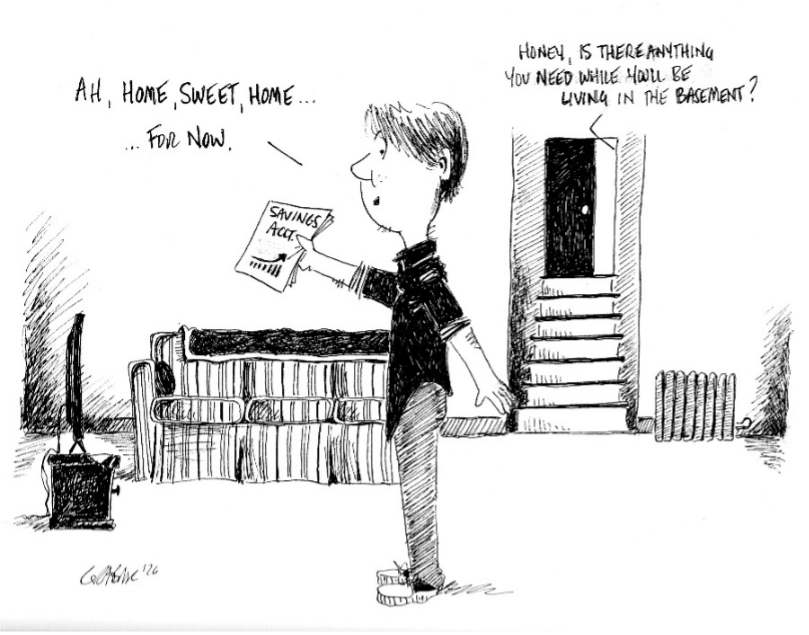
As promised, a few tips and strategies to help with saving for a home.
- The following won’t work for everyone, everywhere, all at once. I use a lot of averages, and they won’t always line up with any given person’s circumstances. It’s important to focus on what you can do, breaking down large goals into smaller ones, and going after them with a steady and dedicated approach.
- The following is not comprehensive, but an attempt to show some concrete options with numbers to make it come alive.
- Saving for a home is likely going to take longer than it did for previous generations.
- Career choice and location choice are critically important and might be a deciding factor.
- There are no legitimate “hacks”. There are choices. There are trade-offs. There is risk and discomfort. There is opportunity.
Strategies
- Set goals, SMART goals, and be on a budget. Specific, Measurable, Achievable, Relevant, Time-Bound. For example, by spending $100/month less on ________________, I will save $100/month in a high yield savings account for three years, which will add about $4,000 to my downpayment fund. For a LOT more on budgeting, see the resources on the side bar.
- Work on that credit score (see part one for more on the reasons why). One neat thing is that many of the steady money habits that will help you save will also build your credit score at the same time. For example, by paying all bills on time over time and by avoiding or minimizing debt, I will strive for a 750-credit score by the time I want to buy a house, which will give me a chance to get the best interest rate possible.
- Keep current housing costs as low as possible. Here is that tough choice thing again, but housing is our top expense and therefore it offers the most impactful choices. Americans value the idea of “getting out on my own” and we do so relatively early compared to many other countries. However, the focus of this blog is dealing with increasingly hard to afford housing prices so… Something has to give. Staying with parents longer if possible (but yes, please, paying some kind of rent for the privilege), is a great way to grow savings quickly. If you have to be on your own, one word – ROOMMATE(S). Share expenses, keep rent much lower, divert the difference into savings. Consider this, $300/month in lower rent expense for just three years could add up to $11,000 towards that downpayment.
- Speaking of large expenses, watch out for the new car trap. The cost of having a car has also gone up at a higher rate than income (hmmm… If housing wasn’t getting all the attention, would there be more of a consumer backlash against car prices?). Most of us need a car for work, and we need work to earn, and we need to earn to save. So, we’re back to the car, and the choice (that word again!) of car is a big one. This is the item where we (typically younger generations, the same group fighting for home ownership) make BIG money mistakes (read about some of mine in this post), and if you are trying to save for a home, it can be a hard mistake to overcome.
- The small stuff also adds up. The average American is spending $75/month on streaming services and over $250/month on eating out. Hello, math! Cutting those numbers in half for three years would yield almost $6,000.
- Your time is money. Just like small expenses add up to big money over time, small amounts of extra income really add up. If your full-time work allows for it, look hard at your spare time and how much of it you could monetize for a few years. Five hours a week at a minimum wage job would add over $200/month after taxes to your wallet. After three years? That’s $7,200.
- Get interested, get your money working for you. Be purposeful about where you keep your savings, understand what you can earn and if there are any risks involved. A high yield savings account pays more interest than standard savings while keeping your money liquid and easy to access. Ask your bank or financial advisor about other ways to save like CDs and ROTH IRAs.
- Avoid (and/or payoff) debt. Doing this will help you take advantage of the previous bullet and build your credit score at the same time. Debt is the opposite of investing, and every dollar you owe slows down the ability to reach savings goals.
- Learn about ALL of the costs of owning a home. Property taxes and insurance alone can add up to several thousand dollars per year, and then of course there is upkeep, repairs, heat, roofs, gutters… Oh my. The bottom line is that you are not just saving for a downpayment, you are saving for a lifestyle, possibly long-term, hopefully wonderful, but definitely loaded with financial surprises.
- Bargains, fixer-uppers, and borders should always be on the list of possibilities. “Sweat equity” is a real thing, it can be measured, and even though I can barely swing a hammer, I can vouch for its value. And buying a home with the intent of renting an extra bedroom for a few years can mean thousands of dollars going toward the mortgage, improvements, etc.
- First-time home buyer programs can help. Check out the options in Maine.
- Look at the above bullets. Add up the savings and extra income from a side gig and in three years…that could add up to nearly $30,000. While that’s typically not enough for a 20% downpayment, it is, after just three years, a huge boost in the right direction. Imagine what a few more adjustments and a few more years could do…
“Buy land, they’re not making it anymore.”
That nugget, from author Mark Twain, sums up why houses not only tend to hold value, but also tend to go up in value. Housing is still viewed as one of the biggest and most stable investments of our lives, and there are no signs now or from history that that is going to change. The other side of that coin is that there are also no signs that housing will suddenly become significantly more affordable either by the invisible hand of economics or by the intentional hand of government. It’s up to us to focus on the goal and the steps needed to get there. I’ve spoken with many who have bought a home in the last few years—friends, former students, and others all much younger than me. Their stories of how they did it include most, if not all, of what I’ve put in this post—most notably, their stories include a combination of goals, time, and choices.
I’ll attach plenty of additional resources, and don’t forget to contact me directly for more on this topic or other financial wellness challenges.
Again, I want to thank Jaden Kyung-Moon Bauch and Hannah Finegold. Jaden is a recent graduate of The Maine College of Art & Design, a financial educator, and the author of an Instagram account and website dedicated to financial wellness (@TheFinancialPalette and https://www.thefinancialpalette.org/.) Hannah is a real estate agent with Hannah Finegold Real Estate at Real Broker, LLC. (And… Hannah is my former student from Waynflete, and Jaden is a former student and co-teacher from Maine College of Art & Design).
About the Author:
Steve has worked on financial literacy efforts in Maine since 2004, and in July 2023 he started at FAME as a Financial Education Programs Specialist. He is an Accredited Financial Counselor (AFC®), a WISE-Certified Personal Finance Educator, has a B.S. in economics from Southern Connecticut State University, an MBA from the University of Hartford, and served as a U.S. Peace Corps Volunteer.
In the fall of 2003, he started a 20-year connection to the Waynflete School in Portland, where he taught math and personal finance, advised middle and upper school students, and coached baseball. Steve worked with students to create the Finance Club and an award-winning LifeSmarts team (Nationals 2013, 2014, and 2015). In 2011, Steve coached a Waynflete team to victory in the Boston Federal Reserve Economics Cup Challenge.
Steve was named Maine Jump$tart Financial Educator of the Year for 2012, was the keynote speaker at the Maine Jump$tart Annual Teacher Conferences in 2015 and 2023, and was Maine Jump$tart’s training coordinator from 2017 to 2023.
Steve and his family moved to Seville, Spain in July 2016 where he taught English and business English and learned many new personal finance lessons. He now lives in Portland with his wife and their son.