




A Money Mindset Shift in the Form of a $9 Payment
This blog addresses personal finance through posts influenced by my experiences (stumbles to say the least) with money, the stages I went through to change direction, and the educational foundation I built along the way. Even though I’d be better off financially having NOT wasted the first decade plus of my earnings, I wouldn’t be better off in terms of how it led to the privilege of teaching personal finance over the following decades in classrooms, conference rooms, Zoom rooms, and in this space.
It’s hard to get through a day without bumping into reminders of those money adventures and of the moments that changed everything for me. The following story highlights one of those moments or turning points in my financial story.
While working just for the health insurance, something funny happened on the way to the Peace Corps
After settling in my one-bedroom Smyrna, Tennessee apartment late in 1993, I had to get a job. I hoped to be leaving for the Peace Corps within 12 months, and in addition to needing the income (oh yeah, I had built up quite a collection of credit card debt which I had to get under control in order to leave for the Peace Corps), I needed health insurance. I attended a job fair in Nashville in January of 1994 and found myself at the Rent-A-Center booth.
I was clueless. Even as I filled out the application, I assumed that Rent-A-Center was a place that rented tools and other things that you might need for a day or two. I knew nothing of the rent to own industry. I don’t think I had even heard of rent-to-own. I’m pretty sure that during the on-the-spot interview I made a comment like, “So, it’s like layaway.”
“No, it’s really not,” replied the interviewer with the most truthful statement in the history of job fairs.
At that time, rent-to-own (RTO) was a more than $3 billion industry in the U.S. alone. That number is now closer to $12 billion.
Why had I never heard of it? Socioeconomic reasons, primarily. Although my parents started our family dirt poor in a Tennessee trailer park, we either never used rent to own and/or I just wasn’t aware of it. Eventually, my folks scratched their way into the middle-class where RTO does not thrive, and I continued to be a stranger to it.
Despite the manager wondering why someone with an MBA wanted to work retail, I got the job and was even entered into the management training program. I didn’t really want the management gig, but it was a little more money, and I figured that it didn’t matter anyway as I expected to be quitting this job in less than a year.
After six months I was transferred to another store and promoted to assistant manager.
Honestly, that VCR will end up costing $800
My first day with Rent-A-Center (RAC) was in late January 1994, at a store in West Nashville where I took on the role of customer account manager in training. That included learning the products in the showroom, how to load/unload/deliver, and, most importantly, how to go over the customer rental agreement (RA), which detailed the payment amount, number of weeks to own, insurance, and total costs if all payments were made. While working at RAC and at times over the years to come, I heard or read stories about deceptive practices in RTO, and RAC was always a target in these reports. I have to say that in the nearly 18 months that I worked there, I never saw anyone take shortcuts when explaining the contract to renters. Our training was thorough. We had to be crystal clear when it came to showing what someone would pay in total if they fulfilled the rent to own contract. I can remember my first manager telling me, “Don’t mess around with the RA, explain every line, get the customer’s initials, and then show them the final cost – show it twice. Last thing you want is someone coming in here and complaining that they paid $828 for a VCR.”
RTO is aimed at the lower income, poor credit/no credit, and sometimes unbanked, demographic. Instead of credit checks and 21% interest credit accounts, RAC’s business model relies on personal contacts of the customer to say how they have known the applicant, do they consider them to be trustworthy, and do they know how to get in touch with them. Based on these conversations, our forms generated a score, and if the score was high enough – bingo! – VCR rented. It was an old-fashioned, efficient, word-of-mouth credit system. Some customers were able to fill out the form and get approval within minutes, and then either take the merchandise with them or arrange for delivery.
RAC’s showrooms included VCRs, TVs, big-screen TVs, stereos, washers and dryers, sofas, recliners, refrigerators, microwaves, coffee tables, and even computers, which in 1994 were nearly as heavy as those big TVs. The shortest contracts I can remember for new items were around 40 weeks, but most contracts were between 52 and 78 weeks. There was no penalty for returning an item before the end of the contract, and plenty – PLENTY as in MOST– never finished their contract and either returned the merchandise, told us to “come get it,” or played cat and mouse with account managers like me who had to “run” customers – showing up unexpected to collect payment or pick up the product (want to hear about the time I had a gun pointed at me while carrying an air conditioner in 99-degree heat?).
The Peace Corps promised to be the “Toughest Job You’ll Ever Love”, and I was ready to soon have my world turned upside down in a foreign land, challenged by cultural and language barriers. Little did I know that my RAC experience – or as my friend called it, “The Worst Job You’ll Ever Hate” – was also going to be life altering and filled with its own set of obstacles cultural and otherwise.
The math of personal finance is always right, but not always convincing
In the early to mid-70’s the first VCRs sold for around $2000 (over $9000 today adjusted for inflation), but by the time I was slinging (through rent to own) them in 1994, an average quality unit retailed for about $175. The same or similar could be said for many products including televisions. Now watch the magic as RAC turns a $150 retail value item into over $800 in revenue in just 78 weeks.
This is a reenactment of the conversation that produced my “Ah-ha!” moment between me and a regular customer with whom I had had many conversations about various RAC products and prices.
ME: What can I do for you today?
CUST: Well, we just finished paying for that VCR – wow that took a long time – and we’re in the market for a second TV to put in the kids’ playroom. I see this one is $9/week.
ME: Yes, well, it’s $9.99 plus tax and insurance*, which makes for a weekly payment of $11.62. It’s a 78-week agreement. If you pay for the entire 78 weeks, you will pay a total of $906.36. The cash price for the item is $175. (*RAC provided service for products in rental contracts, but the insurance offered replacement coverage and extended the coverage beyond the rental term)
CUST: Oh yeah, we need that insurance. Ouch, this is tough, we just paid off that VCR, but money is tight in general. We also have that sofa with you guys at $19 week.
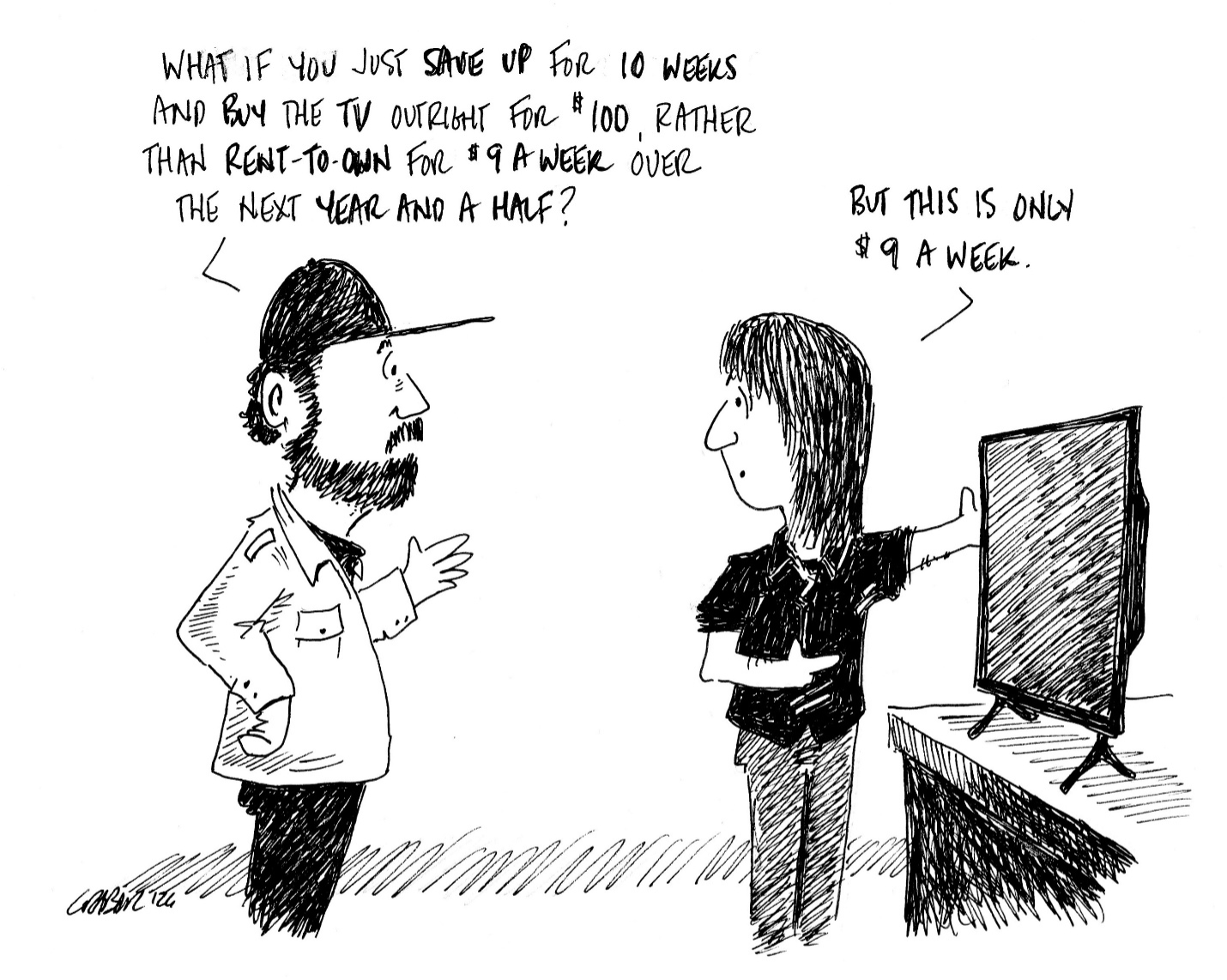
I don’t know why at that moment or with that customer, but something overtook my thoughts and redirected my speech. I knew that the type of TV they were looking for was retailing for around $125, and secondhand options were plentiful and even cheaper. So, ethical questions aside regarding my place as a RAC employee…
ME: I understand, it’s a lot to manage. Um…I happened to see this TV or similar for just over $100 new at Kmart. If the kids can wait, you could put the money aside for a couple of months and buy one in cash. It would save you a bundle in the long run.
A pause and a few sighs…
CUST: But this one is $9/week.
ME: Yes, yes it is. Ok, let’s get started on that Rental Agreement. As you can see, this item…
Ah-ha!
And in that exact, impactful, memorable moment, I realized just how badly I had managed my own money. I relived every credit card swipe for a $20 shirt which would end up costing me double, every payment made towards a car that was beyond my means, every dollar I had not saved for my future self. I thought about how fortunate I was to have a sense for numbers – the math was clear – yet why had I and countless others continued to negatively impact their finances one weekly payment or credit card minimum payment at a time. I also knew that I would not only learn to make better financial decisions for myself but also work towards educating others about personal finance and their money decisions.
Rent-to-own is not the bad guy. It fills a need (and a want) in our system – some of its featured products are necessities (washing machine, refrigerator) – and it is playing its role in our version of capitalism and the pursuit of profit. Some consumers do not have access to conventional credit such as cards or cannot get credit directly from a retailer. However, as the example above shows, the effective finance charge can be in the hundreds of percents. Whether RTO, BNPL, or payday loans, the bigger message is about the importance of saving for goals/purchases and avoiding the high costs of alternative financing.
There were other turning points and ah-has, and I look forward to digging into those in future posts.
About the Author:
Steve has worked on financial literacy efforts in Maine since 2004, and in July 2023 he started at FAME as a Financial Education Programs Specialist. He is an Accredited Financial Counselor (AFC®), a WISE-Certified Personal Finance Educator, has a B.S. in economics from Southern Connecticut State University, an MBA from the University of Hartford, and served as a U.S. Peace Corps Volunteer.
In the fall of 2003, he started a 20-year connection to the Waynflete School in Portland, where he taught math and personal finance, advised middle and upper school students, and coached baseball. Steve worked with students to create the Finance Club and an award-winning LifeSmarts team (Nationals 2013, 2014, and 2015). In 2011, Steve coached a Waynflete team to victory in the Boston Federal Reserve Economics Cup Challenge.
Steve was named Maine Jump$tart Financial Educator of the Year for 2012, was the keynote speaker at the Maine Jump$tart Annual Teacher Conferences in 2015 and 2023, and was Maine Jump$tart’s training coordinator from 2017 to 2023.
Steve and his family moved to Seville, Spain in July 2016 where he taught English and business English and learned many new personal finance lessons. He now lives in Portland with his wife and their son.